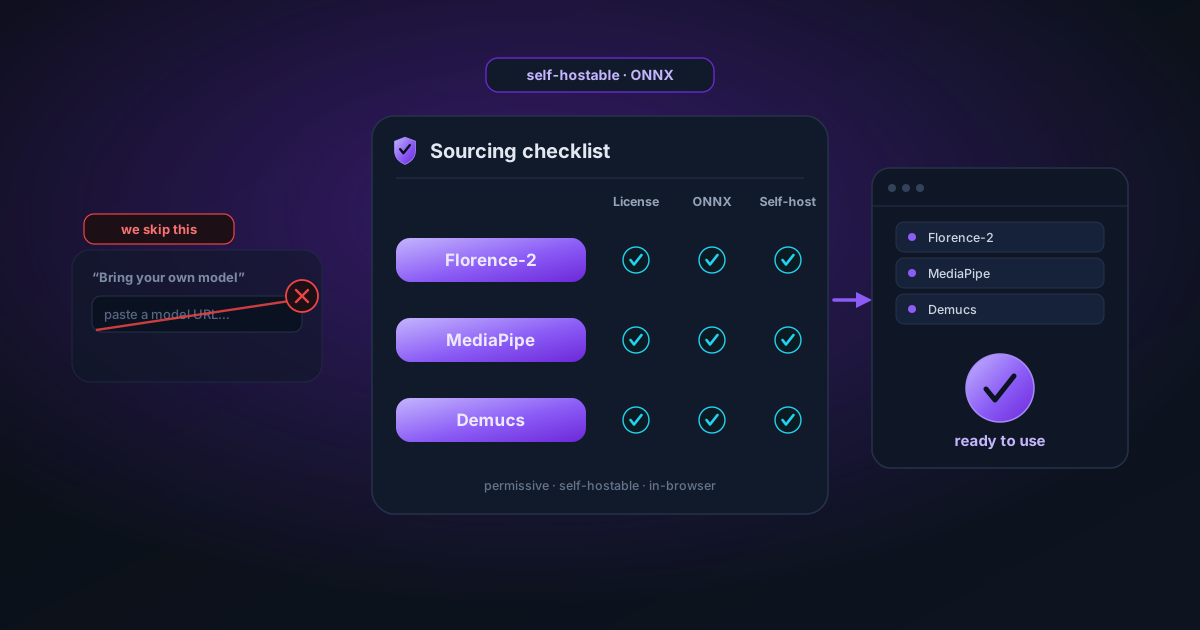
No "Bring Your Own Model": How We Source Client-Side AI Models
Plenty of browser AI tools punt the hard part to you: "paste a model URL." We don't. Our rule for sourcing self-hostable, permissively-licensed ONNX models so every tool works out of the box.
By Novus Stream Solutions Editorial Team · Part of the Image processing and on-device AI topic cluster
A pattern shows up in browser-based AI tools when a feature gets hard: bring your own model. The tool ships a text box where you paste a model URL, and if you don't have one, the feature simply doesn't work. It's a way to claim a capability without actually delivering it. We made a rule against it: every tool gets a real, self-hostable, permissively-licensed model: or it's honestly gated, never faked.
That rule turns "source a model" into a concrete research checklist. Here's how we evaluate one.
The four questions for every model
- Does a web-ready ONNX export exist? Not a PyTorch checkpoint, an ONNX file that ONNX Runtime Web or Transformers.js can actually load. Many famous models have no clean web export, which quietly kills them as client-side options.
- Is the license permissive enough to self-host? We need to serve the weights ourselves (MIT/Apache and similar). A research-only or non-commercial license is a non-starter for a free public tool.
- Does it fit the browser's constraints? Download size that's honest to gate, and, critically, a compute graph that fits WebGPU's limits or runs acceptably on WASM. (A model that needs 33+ storage buffers per shader stage won't survive WebGPU's 8-buffer floor on many devices.)
- What's the exact I/O contract? Input tensor shape, normalization, output decoding. Without this you can load a model and still get garbage.
What that yielded this round
- Florence-2 (
onnx-community/Florence-2-base-ft): one model that upgrades captioning, OCR, alt-text and VQA, replacing weaker single-task models. MIT. The catch we documented: it's quantization-sensitive in the encoder, so you must set per-module dtypes (keep the vision encoder higher precision) or OCR comes out garbled. - MediaPipe Tasks Vision (
@mediapipe/tasks-vision): fully client-side pose, hand, and face-mesh landmarks. Apache-2.0. This is the honest path for pose-conditioned generation and for constraining eye-colour edits to the actual iris instead of recolouring the whole image. - Demucs v4 ONNX: a self-contained ONNX export (STFT/ISTFT rewritten to be ONNX-compatible) for audio stem separation, runnable via ONNX Runtime Web. MIT.
For each, we recorded the URL, license, size, and I/O contract in our model catalog before wiring, so "does this tool use the right model?" has one audited answer instead of being scattered across modules.
The honest-gate fallback
Sometimes the answer to the four questions is "not yet". No clean export, or it's too heavy to ship responsibly. In that case the tool shows a clear "not available yet" state. What it never does is return your input and call it a result. A feature that says "coming soon" is honest; a feature that fakes its output is not.
Why this is more work, and worth it
"Bring your own model" is easier for us and worse for you: it offloads the genuinely hard part (finding a model that's web-ready, licensed, and fits the device) onto the user. Doing that work ourselves is the difference between a tool that lists a capability and a tool that has one.
Applies to NSS Background Remover v1.5.0 — the release that was current when this article was published.
Was this article helpful?
Your answer is saved in this browser only. This control makes no network request and does not send the answer to an NSS feedback endpoint.